It blows my mind that work on Claude Code started only about 2 years ago. I am not aware of any other technology that reshaped so dramatically and so quickly how people go about doing their jobs - in at least one profession (software engineering), if not others too.
Of course Claude stood on the shoulders of other prior important technological advancements - transformers and ChatGPT, just to name a few - but, it is hard to argue that it was not a main trigger that brought the practicality and efficiency that catapulted our use of AI Systems.
In this insightful discussion, Boris Cherny - the Claude Code creator - talks about, in easy to understand terminology, essential Claude Code concepts, its history and future.
The parts I want to emphasize are those around the role tools play in agentic coding and how I think about adopting them in my workflows.
Agents need tools
Between minutes 13 and 22 Boris describes that:
- There are 2 kind of AI Systems:
- Chatbots: used just for receiving information
- Agents: they do things for the user, and they need tools to do this
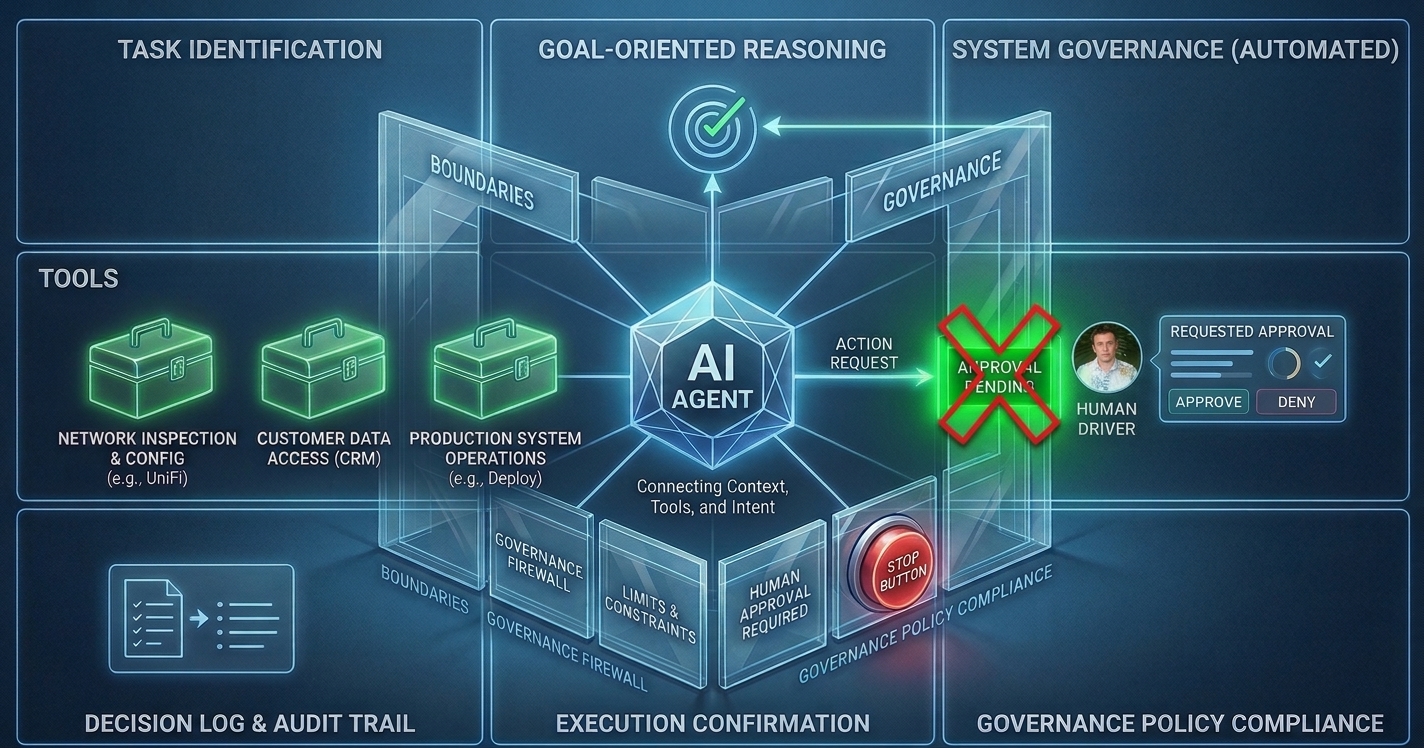
- So what does an Agent do: takes input from a human or another agent -> feeds it to an LLM model -> which then decides how to use tools to accomplish the task at hand.
- Claude Code itself is an agent and initially was rolled out with just 3-4 basic tools (read files/directories, write code files and execute commands on the computer).
So tools make the LLM models become useful for their users. Over time their number grew exponentially - e.g.: tools provided with the Coding Assistants (Claude Code, Codex, GitHub Copilot, etc), skills developed by 3rd party providers, tools/skills custom developed by the users of Coding Assistants, etc.
Tools need boundaries
While observing the Coding Assistants behavior and through experimentation, I pay attention often to the kind of information and the systems they need to access (and/or try to access) to do a better job at accomplishing their goals/tasks. Sometimes these interactions begin just as exceptions to the initial limits put on these assistants, in terms of what they can do in the environment where they run and how/what external systems they can use.
As described in this other article on this topic exceptions mean I have to provide approvals for overrides. And exceptions mean that risks will be introduced as the assistants will start doing things they have not done before and it is very likely my attention will not capture all possible repercussions of what I am approving. So while I still want to have the big red button to push if I need to stop everything, the better path is to take myself out of the picture and not have to approve tools usage.
And how to do that?
Just like I would not want to cut a large tree log with a handsaw but instead use a chainsaw (and very likely with safety glasses on), it would be better to devise the properly sized AI tool for the job at hand, with the necessary guardrails around it, to know that it will be used safely.
So for e.g. instead of approving an exception for a Coding Assistant to SSH into another machine, I would want to stop an create instead a dedicated SSH tool that sets up a login account that is strictly limited only to actions that the Coding Assistant should be able to perform on the remote machine. And make sure that the Coding Assistants understand that using this SSH tool is the only way they can access the other machine.
Implications on designing software for external use
Another important corollary of AI Agents being essentially a smart LLM model with bash commands behind them: when developing software today it is helpful to take in consideration how our software can become a tool.
Years ago the concept of API-First development emerged to solve the friction of building isolated backends by designing application interfaces before writing code, ensuring seamless cross-platform client compatibility, scalable team autonomy, and parallel microservice development.
Today, I think we need to design for a CLI-First approach, deployed with the knobs and configurations that allow its client Agents to safely use our software to accomplish the end-user’s goal. Another approach is to deploy an MCP server as the interface for AI Systems to interact with our software.
In conclusion, I find it useful to always be on the watch for tools I can provide or improve to make my agents more efficient and then put that same hat on when I think about how my software will be used.